🔥 New! 2025 AMC 10 B
Complete problem set with solutions and individual problem pages
Each of the squares in a grid is to be colored red, blue, or yellow in such a way that each red square shares an edge with at least one blue square, each blue square shares an edge with at least one yellow square, and each yellow square shares an edge with at least one red square. Colorings that can be obtained from one another by rotations and/or reflections are to be considered the same. How many different colorings are possible?
- A.
- B.
- C.
- D.
- E.
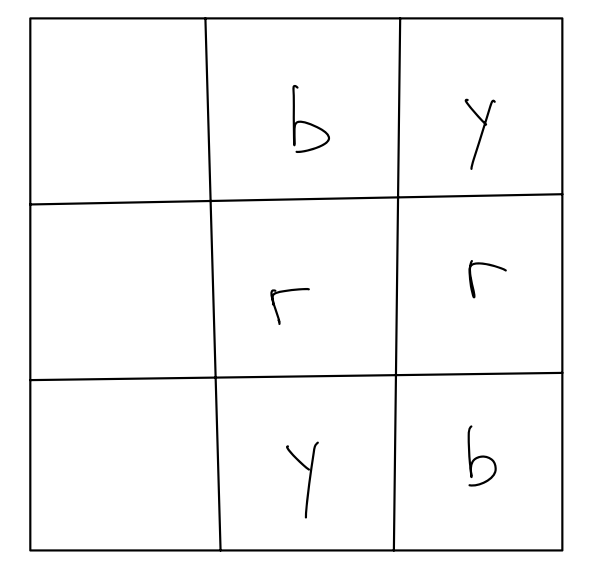
Assume the color of row , column is .
Consider the center grid when it is red.
At least one of , , , is blue.
Suppose = blue (WLOG).
At least one of , is yellow, assume is yellow (WLOG).
Then considering , at least one of and must be red, meaning = red.
Considering , one of its neighbors is blue, meaning = blue.
Considering , one of its neighbors is yellow, meaning = yellow.
For the remaining 3 grids, there are 3 cases:
Case 1: = red, then = blue or = blue.
If = blue, its neighbor does not have yellow (contradiction!).
Thus = blue, and can be either red or yellow. 2 ways.
Case 2: = yellow, then the neighbors of are all yellow, so = blue. can be either red or blue. 2 ways.
Case 3: = blue, then = yellow or = yellow.
However, neither has a neighbor with color red (contradiction!).
By shifting the colors, the total number of ways .
