🔥 New! 2025 AMC 10 B
Complete problem set with solutions and individual problem pages
Problem 20 Easy
Four congruent semicircles are inscribed in a square of side length so that their diameters are on the sides of the square, one endpoint of each diameter is at a vertex of the square, and adjacent semicircles are tangent to each other. A small circle centered at the center of the square is tangent to each of the four semicircles, as shown below.
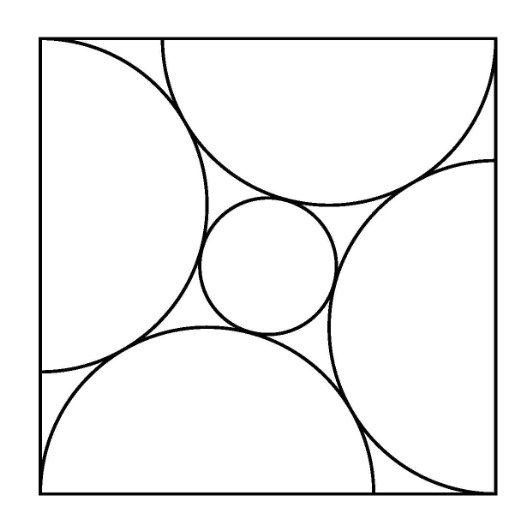
The diameter of the small circle can be written as, where , and are integers. What is ?
- A.
- B.
- C.
- D.
- E.
Answer:A
Solution
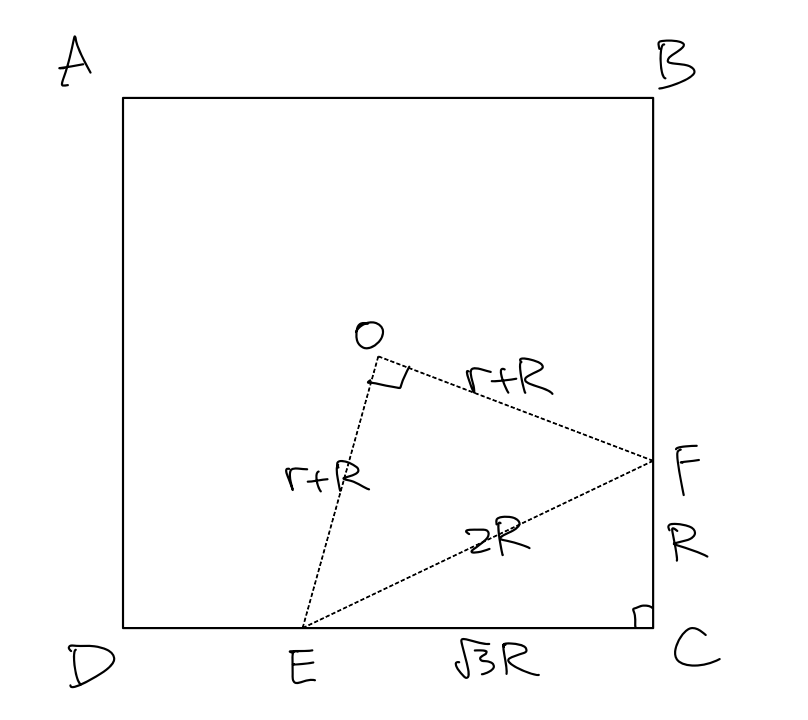
Let be the radius of the small circle and be the larger radius.
Let be the centers, then and .
Since and , we have and .
Then:
Since by symmetry, , i.e., .

Think Academy Powered by ChatGPT