🔥 New! 2025 AMC 10 B
Complete problem set with solutions and individual problem pages
Problem 25 Easy
Square has sides of length . Points and lie on and , respectively, with and . A path begins along the line segment from to and continues by reflecting against the sides of (with congruent incoming and outgoing angles), as shown in the figure. If the path hits a vertex of the square, then it terminates there; otherwise it continues forever.
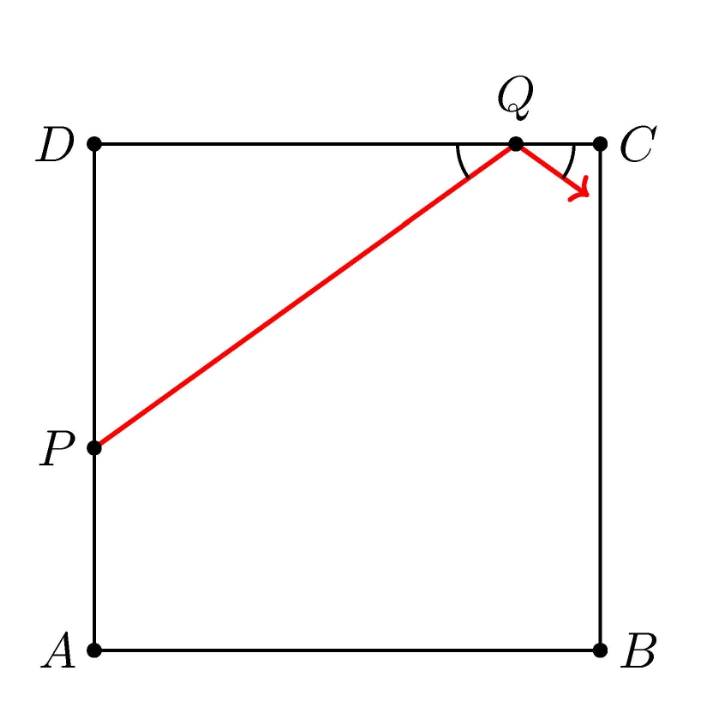
At which vertex does the path terminate?
- A.
- B.
- C.
- D.
- E.
The path continues forever.
Answer:B
Solution
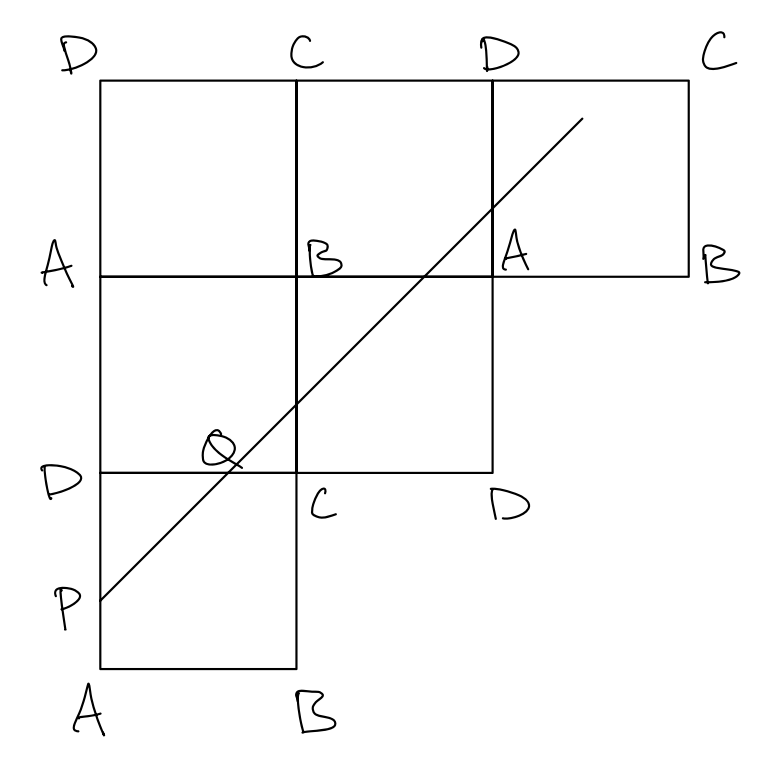
We can let the line keep going, making the square reflected.
It suffices to check if line passes for some .
Let line : , then .
So : .
For and : .
The solution is a positive integer solution.
It can be proved that are images of , are images of , are images of , and are images of .
Therefore is an image of .

Think Academy Powered by ChatGPT